Open Chiplet Atlas Ecosystem
The Open Chiplet Atlas® (OCA®) Ecosystem defines open standards that enable plug-and-play integration of chiplets from different vendors, fostering a flexible, interoperable ecosystem for chip design and packaging.
It also provides assistance to simplify and expedite chiplet design and System in Package (SiP) integration.
For the latest development, please visit the OCA news and updates (Opens in new tab).
Overview
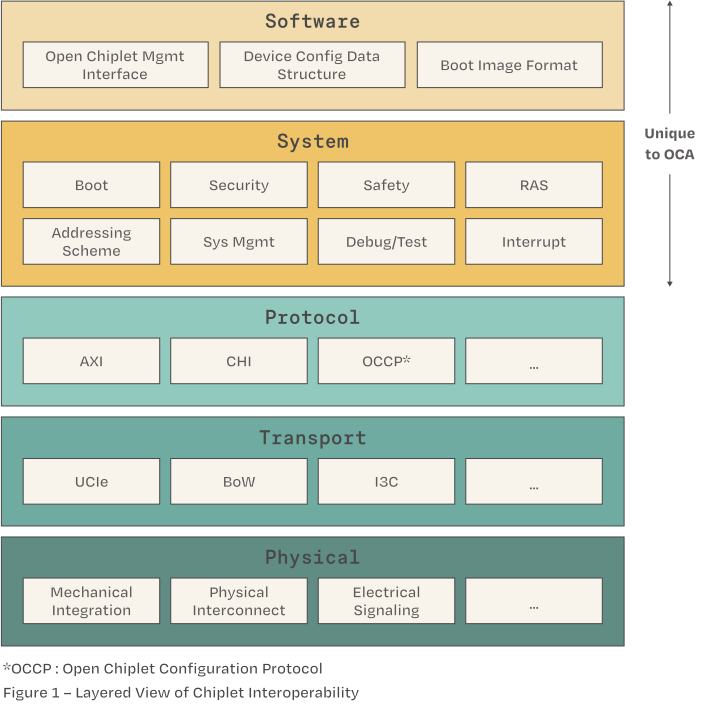
The Open Chiplet Atlas Architecture is designed to achieve full interoperability among chiplets from different vendors, making them truly ‘plug-and-play’ within a single package. The OCA architecture is open, built on industry standards, and IP agnostic. Unlike other specs that stop at Physical, Transport, or Protocol layers, the OCA architecture is full stack – extending into Systems and Software for true end-to-end composability.
Ultimately, the OCA architecture fosters an open chiplet ecosystem where chiplet designers can access IPs with well-defined, interoperable interfaces, and package integrators can assemble System-in-Packages (SiPs) using chiplets from various sources. This complements traditional silicon design by also empowering package integrators to participate in chip innovation through integration. All without license fees and royalties.
The OCA Architecture is an open standard with open source software. No vendor lock-in at any layer. No licensing fees or royalties.
Leverages industry standards wherever possible.
Extends through the systems and software layers of the stack.
Integrated in 2026 next gen chiplets.
White Paper
For more information, download the Open Chiplet Atlas Architecture White Paper.
Challenges
Today, chiplet standards face the following challenges. The OCA ecosystem solves these challenges for an open future.
Domain
Interconnect
Chiplets need to establish correct connections and efficient communication across all layers including physical, transport, and protocol.
Addressing
Independent address mapping across chiplets complicates scenarios where one chiplet needs to access another chiplet’s resources.
Boot
Boot dependencies between chiplets require cross-vendor alignment on communication protocols, boot configuration, and boot flow coordination.
System Management
Timely servicing system management commands and managing control loops across chiplets present significant coordination and communication challenges.
Security
Variations in chiplet security architectures, such as security-domain partitioning and lifecycle control, create integration challenges and potential vulnerabilities.
Interrupts
Inconsistent interrupt implementations across chiplets complicate cross-chiplet interrupt delivery and handling.
FuSa and RAS
Ensuring FuSa and RAS interoperability across chiplets is challenging due to architectural diversity and the need for inherently robust solutions.
Debug and Test
Debug and test support across chiplets is complicated by the lack of uniform access ports and inconsistencies in triggers, timestamps, and trace mechanisms.
Software
Software interoperability across chiplets is hindered by vendor-specific hardware-software interfaces and inter-software communication protocols.
The OCA Ecosystem solves these challenges for an open future.
Specifications
The OCA system architecture is structured into five layers — where other standards are limited to three — to support plug-and-play chiplet integration. From top to bottom, these are Software Layer, System Layer, Protocol Layer, Transport Layer, and Physical Layer. Each layer abstracts the one below it, allowing flexibility and avoiding dependence on specific lower-layer solutions.
The OCA AXI over UCle (AoU) Specification aims to bridge non-coherent Network on Chips (NoCs) on different UCle-connected chiplets in an interoperable and efficient manner. It is focused on bandwidth efficiency, extensibility, and ease of adaptation to current SoCs.
The OCA specifications are in active development and will continue to evolve. View the latest version above.
To see previous versions of the OCA Specifications, please visit the OCA Library.
Open Chiplet Atlas Harness
The Open Chiplet Atlas® (OCA) Harness is an open-source framework for building chiplets with reusable system infrastructure. Built around the OCA Architecture, it brings together the common building blocks chiplet teams need, including security, system boot, system management, debug, test, and die-to-die connectivity, so teams can spend more time on the application logic that makes their chiplet unique. Explore the documentation to see how the framework comes together, or visit GitHub to browse the RTL and DV source code.
Partners